8 Days Imperial Cities Tour Morocco – Authentic Private Experience
The 8 days imperial cities tour Morocco is the most complete cultural journey you can make in a single week — four ancient capitals, three UNESCO World Heritage medinas, the best-preserved Roman ruins in Africa, and a return through a cedar forest inhabited by wild Barbary macaques. All of it in a private vehicle with a guide who knows which doors to open and which detours change the entire trip. This is not a coach tour of façades. Two certified local guides — one in Marrakech, one in Fes — take you inside the cities that shaped Moroccan civilisation, at a pace that leaves room to sit in a souk, drink tea with a tanner, and watch Djemaa el-Fna ignite at nightfall. This tour suits first-time visitors to Morocco who want depth over distance, and returning travellers who know the postcards and want what is behind them.
Why This 8 Days Imperial Cities Tour Morocco Is Built Differently {#why}
Nearly every imperial cities Morocco tour starts in Casablanca and ends in Marrakech — or vice versa — in a straight line. Ours starts and ends in Marrakech, runs a complete loop through the north, and takes two structural decisions that change the quality of the trip entirely. First: Moulay Idriss Zerhoun is an overnight stop rather than a 30-minute drive-through. The holy hilltop city above Volubilis — where non-Muslims were not permitted to spend the night until 2005 — is at its most extraordinary after the day-trippers leave. Your group will have it at dusk, at dawn, and at breakfast, before the coaches arrive. Every competitor makes this a brief stop. We stay.
Second: Fes gets two full days with a certified local Fassi guide, not one rushed day. The UNESCO medina of Fes el-Bali is the world’s largest car-free urban area — a city within a city that has operated continuously since the 9th century. One day skims the surface. Two days lets you reach the Al-Qarawiyyin University courtyard, the tanneries at the right light, the artisan quarter where coppersmiths have worked the same lane for three centuries, and still leaves an afternoon free for a hammam or a panoramic view from the Borj Nord fort above the medina.
The route also takes in Sefrou on the way into Fes — a Berber-Jewish town 30 kilometres from the city with a waterfall inside its medina walls, a mellah that tells Morocco’s Jewish story with extraordinary candour, and almost no foreign visitors on any day of the year. Read what past travellers say about why an extra day in the right city matters more than an extra city on the map.
What’s Included in Your 8 Days Imperial Cities Tour Morocco {#included}
Every booking is 100% private — your group, your vehicle, your guide throughout all eight days.
✅ Included:
- Private air-conditioned vehicle for all transfers
- English, French, and Arabic-speaking driver-guide throughout
- Certified local guide in Marrakech (Day 1)
- Certified local guide in Fes (Days 4–5)
- 7 nights accommodation in riads and boutique hotels
- Breakfasts all 7 mornings
- Dinners on Days 1, 3, 4, and 5 at riad or hotel
- Hotel pickup and drop-off in Marrakech
❌ Not Included:
- International flights
- Travel insurance
- Lunches (we recommend specific spots at each stop)
- Entrance fees (Hassan II Mosque, Volubilis, Bahia Palace — moderate, paid on site)
- Personal expenses and souvenirs
- Tips for guide/driver
All tours are 100% private. We confirm your exact price within 24 hours.
8 Days Imperial Cities Tour Morocco — Day-by-Day Itinerary {#itinerary}
Day 1 — Marrakech: The Red City
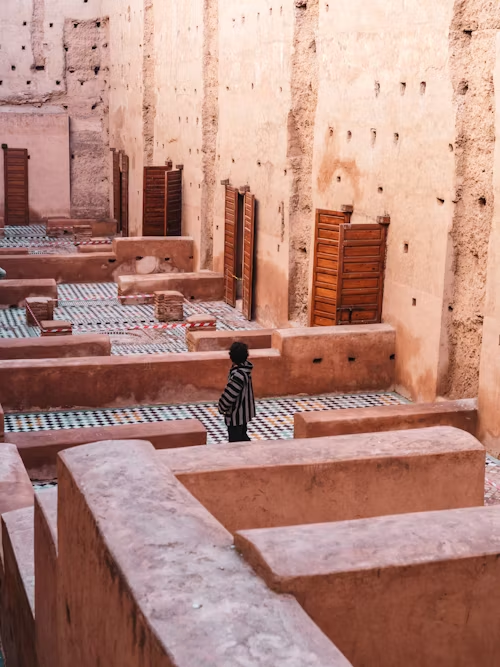
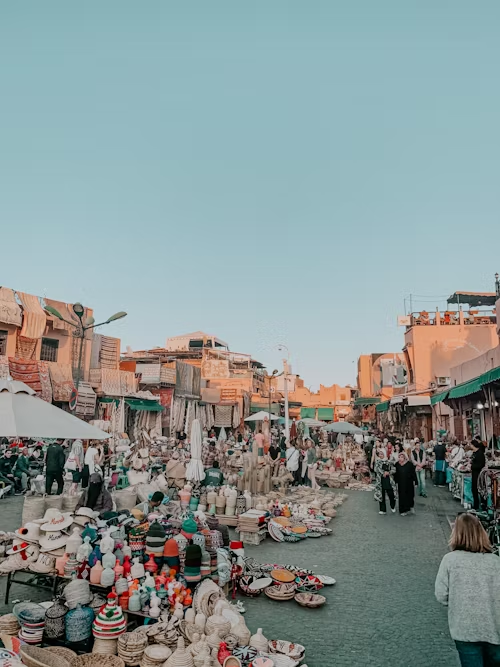
Your certified local guide meets you at your riad after breakfast. The morning covers the essential Marrakech: Koutoubia Mosque and its 12th-century minaret, the golden gate of Bahia Palace, the candlelit chambers of the Saadian Tombs, and a walk through the artisan souks divided by craft — leather-workers, dyers, weavers, spice merchants, each quarter unchanged in layout for five centuries. After lunch near the Mellah, the afternoon is free for the medina at your own pace. As the light fades, Djemaa el-Fna transforms: storytellers take their positions, musicians tune their guembris, food stalls wheel into place. The square at nightfall is the most theatrical public space in Africa and the reason most travellers remember Marrakech for the rest of their lives. Overnight in a medina riad.
Day 2 — Marrakech → Casablanca → Rabat
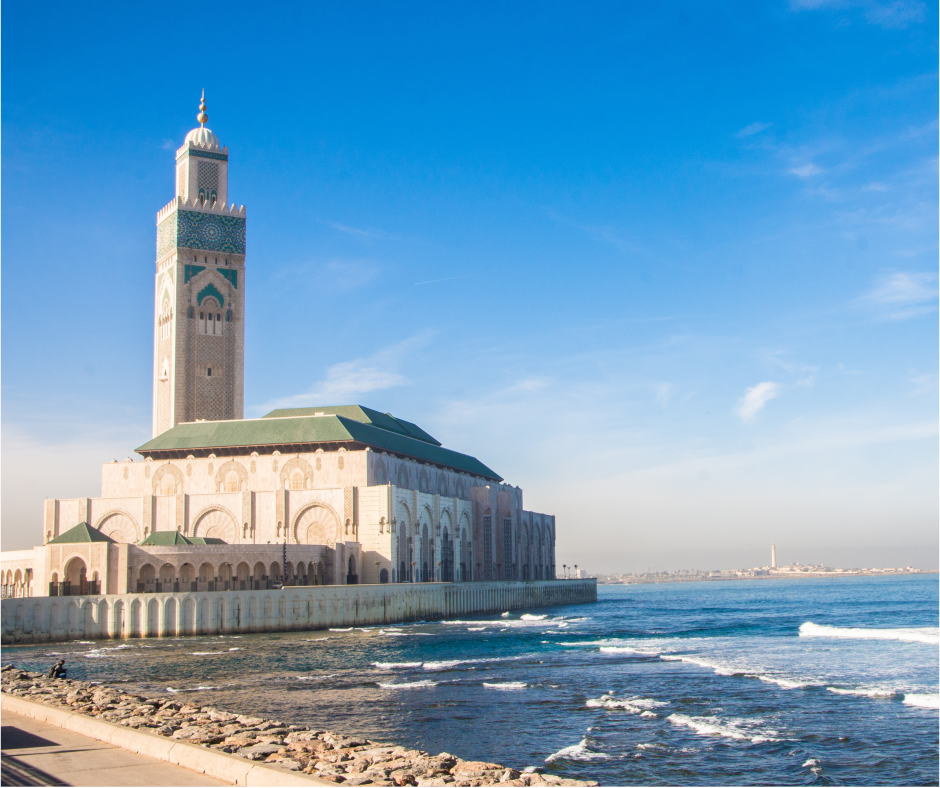
Depart at 8:00 AM. The drive north to Casablanca (3 hours) ends at Hassan II Mosque — one of the largest mosques in the world and the only one in Morocco open to non-Muslims. Built over the Atlantic Ocean on a glass floor, it holds 25,000 worshippers inside and another 80,000 in its courtyard. Continue north to Rabat, Morocco’s royal capital since the French Protectorate of 1912. Your guide walks you through three centuries of history in two hours: the Kasbah of the Udayas — a UNESCO-listed 12th-century Almohad fortress perched above the mouth of the Bou Regreg river, with a Moorish garden and whitewashed alleys painted in blue — Hassan Tower, the unfinished 12th-century minaret that would have been the tallest structure in the Islamic world, and the Mausoleum of Mohammed V, the finest example of contemporary Moroccan craftsmanship in the country. Overnight in a boutique hotel near the Rabat medina.
Day 3 — Rabat → Meknes → Volubilis → Moulay Idriss Zerhoun (overnight)
Morning in Rabat: optional walk through the Chellah — Merinid ruins built over Roman foundations on the city’s edge, home to nesting storks and centuries of layered history. Drive to Meknes (2 hours): Bab Mansour, the most ornate gate in Morocco, inlaid with green-and-white zellige and standing 16 metres high; the vast royal granaries and stables of Sultan Moulay Ismail, who built a city to rival Versailles in the 17th century; and Place el-Hedim, the grand square that connects the imperial and civilian quarters. Then north to Volubilis — the southernmost city of the Roman Empire, abandoned in the 11th century and partially excavated since the 19th. The 2nd-century mosaic floors remain in situ: Bacchus pulled across the sea by dolphins, Diana surprised by Actaeon, an athlete being crowned with laurel. A Triumphal Arch still stands. The views from the Capitoline Temple across the Zerhoun plain are immense.
Instead of backtracking to Fes or Meknes, you spend the night in Moulay Idriss Zerhoun — the holy hilltop city 4 kilometres from the ruins, named after the founder of Morocco’s first Islamic dynasty. Non-Muslims were prohibited from overnighting here until 2005. After the last day-tripper leaves, the town belongs to pilgrims, locals, and your group. Dinner in your riad. The silence above the Zerhoun mountains is complete. Night in Moulay Idriss Zerhoun.
Day 4 — Moulay Idriss Zerhoun → Sefrou → Fes
Wake early for a morning walk through Moulay Idriss before anyone else arrives: the Sentissi minaret — the only cylindrical minaret in Morocco, its surface inscribed with Quranic verses — panoramic views from Khaybar hill, and the olive-scented lanes of a town that has changed little since the 18th century. Then drive to Sefrou, 30 kilometres south of Fes — a stop that appears on almost no standard imperial cities Morocco tour. Known as Little Jerusalem for its historically large Jewish population, Sefrou has a waterfall that tumbles through the medina walls and a mellah where Hebrew inscriptions still mark doorways above Arabic carvings. It is one of the most vivid records of Morocco’s multicultural past, and on most days you will have the old city almost entirely to yourselves. Then to Fes, check in to your riad inside Fes el-Bali. Evening guided walk at golden hour: Bou Inania Madrasa, the tanneries from the terrace above, and the Medersa el-Attarine in the last light. Night in Fes el-Bali.
Day 5 — Fes: A Full Day Inside the Medieval Medina
The UNESCO-listed medina of Fes el-Bali is the world’s largest car-free urban area and the oldest continuously operating medieval city on earth. Your certified Fassi guide leads the full day. Al-Qarawiyyin University — founded 859 AD, recognised as the oldest continuously operating university in the world — its library holds manuscripts that predate print. Chouara Tannery: viewed from a terrace above, the 11th-century dyeing pits are arranged in a honeycomb of stone vats filled with ochre, poppy red, mint green, and natural white — the colours changing with each season’s dye. Nejjarine Museum of wooden arts in a restored 18th-century caravanserai. The Royal Palace gates: seven tonnes of hand-hammered brass that took craftsmen decades to complete. Bou Inania Madrasa interior — the finest Marinid stonework in Morocco, with cedar carving, stucco lacework, and geometric zellige rising from floor to ceiling. Free afternoon: hammam, Mellah exploration, or the panoramic view from Borj Nord fort. Second night in Fes el-Bali.
Day 6 — Fes → Ifrane → Azrou → Marrakech
The return to Marrakech takes the Middle Atlas mountain route — a completely different landscape from the outward journey and one of the most underrated drives in Morocco. Ifrane: a French protectorate-era alpine village at 1,650 metres, with European-style chalet roofs and a famous stone lion in the town square. It surprises every visitor. Azrou, 17 kilometres further: the cedar forest where wild Barbary macaques live freely in the trees. Stop, walk among the ancient cedars, and encounter the macaques at close range — these are the same species that inhabit Gibraltar, and this forest is one of the last places on earth where they live wild. Continue south through the Atlas highlands, arriving in Marrakech early evening. Final overnight in a medina riad.
Day 7 — Marrakech: Second Day at Leisure
Marrakech rewards a second look. Majorelle Garden — the electric-blue botanical garden designed by French artist Jacques Majorelle and restored by Yves Saint Laurent — and the adjacent YSL Museum. Menara Gardens, where a 12th-century pavilion sits at the edge of a vast olive-grove reservoir with the Atlas behind it. A traditional hammam session. A half-day excursion to the Ourika Valley in the Atlas foothills, or a Moroccan cooking class in a medina kitchen. The afternoon and evening are free. Final overnight in Marrakech.
Day 8 — Departure
Transfer to Marrakech airport or final drop-off at your accommodation.
8 Days Imperial Cities Tour Morocco Highlights {#highlights}
Four Capitals, One Private Vehicle — Marrakech, Rabat, Meknes and Fes
Morocco’s four imperial cities were each the seat of a different dynasty at the height of its power. Marrakech built by the Almoravids in the 11th century. Fes founded by the Idrisids in the 9th century and refined by the Marinids. Meknes constructed almost from scratch by Sultan Moulay Ismail in the 17th century to rival the courts of Europe. Rabat established as a military base, transformed into a capital by the French Protectorate, and designated a UNESCO World Heritage City in 2012 for its blend of historic and colonial urban planning. Your private Morocco imperial cities tour connects all four in a single coherent journey — not as a checklist, but as a story of four dynasties and twelve centuries.
The Night Nobody Takes — Overnight in Moulay Idriss Zerhoun
Moulay Idriss Zerhoun sits 4 kilometres from Volubilis on a hilltop above the Zerhoun plain, named after the man who introduced Islam to Morocco and founded the country’s first dynasty. Every 8-day imperial cities tour of Morocco passes through it. Almost none stay the night. Until 2005 they couldn’t — non-Muslims were banned from overnighting in this holy city. Now they can, and the experience of the town after the day-trippers leave is entirely different from what any coach tour offers: the mausoleum courtyard in the evening light, the call to prayer echoing across two hills, mint tea in a tiny riad with views across the Zerhoun plain to the distant ruins. It is the single most distinctive stop on this itinerary.
Two Full Days in Fes el-Bali with a Certified Local Guide
The medina of Fes is not a site — it is a living city of 150,000 people operating according to medieval urban logic, where tanners tan, weavers weave, and coppersmiths hammer in the same lanes their ancestors occupied a thousand years ago. One day gives you the overview. Two days with a certified Fassi guide give you the Al-Qarawiyyin library courtyard, the Chouara tannery in morning light, the restored caravanserai of the Nejjarine, and time to sit in a medina café and let the city come to you. The 8 days imperial cities tour Morocco format is the only way to allocate Fes what it actually requires.
Volubilis — Roman Africa at Its Most Complete
The ruins at Volubilis represent the southernmost extension of the Roman Empire, a provincial capital of 20,000 people abandoned in the 11th century and left largely intact beneath the Moroccan soil until excavation began in the 19th century. The mosaic floors visible today — Orpheus charming the animals, the Labours of Hercules, Bacchus and the dolphins — were the floors of private townhouses, not public monuments. Walking between them, you are walking through someone’s living room. The Triumphal Arch still stands. The view from the Capitoline Temple across the Zerhoun plain to the distant Atlas is one of the finest in Morocco. Explore all our Morocco tours for more itineraries built around the country’s ancient and imperial heritage.
Practical Information for Your 8 Days Imperial Cities Tour Morocco {#practical}
What to pack: The imperial cities circuit covers three climate zones in eight days — Marrakech’s warm semi-arid air, the cooler Atlantic coast at Rabat, the high-altitude Middle Atlas at Ifrane and Azrou. Light layers that add and remove easily serve better than heavy clothing. Modest dress is required at Hassan II Mosque and all medina visits — covered shoulders and knees for women, no shorts for men at religious sites. Comfortable walking shoes are essential for the medina cobblestones of Fes and Marrakech, and for the uneven terrain at Volubilis. A light scarf doubles as sun protection at the Roman ruins and respectful cover at Moulay Idriss.
Best season: March to May and September to November are the finest months for this 8 days imperial cities tour Morocco — temperatures comfortable throughout, crowds manageable, and the Middle Atlas route on Day 6 at its most beautiful. Fes in October is particularly exceptional: harvest light, cool evenings, and the medina in its working rhythm. Summer is possible with adjusted timing — both Fes and Marrakech are hot in July and August, though the Atlantic coast at Rabat and the altitude at Ifrane provide relief. Winter is mild along the coast and in the cities, though the Azrou cedar road can be snowbound in January and February. For current forecasts across the route, the Morocco Met Office covers all regions.
Pace and fitness: This tour is designed for comfort. The longest single drive is Marrakech to Casablanca and Rabat on Day 2 (approximately 5 hours including the Hassan II stop), and the Middle Atlas return on Day 6 (approximately 6 hours with stops). No day involves strenuous physical activity — the medina walks are at a comfortable pace, Volubilis is flat, and Moulay Idriss Zerhoun’s climbs are short. Suitable for all ages including older travellers and young children.
Frequently Asked Questions {#faq}
What are Morocco’s four imperial cities?
Morocco’s four imperial cities are Marrakech, Fes, Meknes, and Rabat — each served as the seat of government and royal court for a different dynasty at different points in Moroccan history. Fes is the oldest, founded in 789 AD by Moulay Idriss I and expanded by his son Idriss II. Marrakech was established in 1070 by the Almoravid dynasty. Meknes was built as a grand capital by Sultan Moulay Ismail in the 17th century. Rabat has been Morocco’s administrative capital since the French Protectorate of 1912. Our 8 days imperial cities tour Morocco visits all four in a single private journey.
How long does an imperial cities tour of Morocco take?
Eight days is the standard and the right length for covering all four imperial capitals without feeling rushed. Some operators offer condensed five or six-day versions, but these either skip one city entirely or give Fes a single day — which is not enough. Our 8 days imperial cities tour Morocco allocates two full days to Fes, overnight stays in Moulay Idriss Zerhoun and Rabat, and a leisurely Middle Atlas return rather than a straight highway drive.
Is 8 days enough to see Morocco’s imperial cities?
Eight days is genuinely sufficient for a complete and satisfying imperial cities tour if the itinerary is well-structured. The key is not rushing Fes, which most shorter tours do. With two days in Fes, one overnight at Moulay Idriss Zerhoun, a full morning at Volubilis, proper time at the Rabat monuments, and two days in Marrakech, you leave with a real understanding of Morocco’s dynastic history — not just a collection of photographs of gates.
What is the best time of year for an imperial cities tour of Morocco?
Spring (March to May) and autumn (September to November) are ideal — pleasant temperatures in all four cities, manageable visitor numbers, and the Middle Atlas mountains in their best condition for the Day 6 return drive. October is particularly recommended for Fes, when the city is in its full working rhythm and the light in the medina is extraordinary. Summer is workable but Fes and Marrakech are genuinely hot; Rabat and the Atlantic coast stay cooler. Winter is mild and uncrowded — a good option for those who don’t mind the possibility of snow on the Azrou cedar road.
Do I need a guide for the medina of Fes?
A certified local guide is not strictly required but makes an enormous difference to the experience of Fes. The medina has over 9,000 streets, no signage, and a logic that takes years to understand — your certified Fassi guide not only navigates but explains the social, architectural, and commercial structure of a city that has operated this way for over a millennium. Our 8 days imperial cities tour Morocco includes a full certified Fassi guide for both Fes days, which is one of the reasons our Fes experience consistently stands apart from self-guided or driver-only versions.
How to Book Your 8 Days Imperial Cities Tour Morocco {#book}