Zagora Desert Tour from Marrakech – Private 2-Day Overnight
A Zagora desert tour from Marrakech packs more of Morocco’s south into 48 hours than most travellers expect — and asks something honest of you in return: this is a long-drive trip. Marrakech to Zagora is roughly 350 kilometres, seven to eight hours of driving each way including stops. Over two days you cross the Tizi n’Tichka pass at 2,260 metres, walk the UNESCO ksar of Aït Benhaddou, drive the length of the Draa Valley’s 200-kilometre date palm corridor, sleep in the desert, watch the sunrise, and return through the Atlas from the south. The desert you arrive at is the hammada — Morocco’s stone and rock plateau desert, dramatic and austere, with small sand dunes rather than the towering orange erg dunes of Merzouga. This distinction matters, and every booking conversation we have includes it: if your primary goal is Saharan dunes, the Merzouga route is the right choice. If you want the full pre-Saharan south of Morocco — the UNESCO ksar, the ancient caravan valley, the silence of a desert camp — in a private vehicle with your own group, the Zagora desert tour from Marrakech delivers that completely.
Table of Contents
Zagora or Merzouga — Choosing the Right 2-Day Desert Tour {#choice}
The Zagora desert tour from Marrakech and the Merzouga desert circuit are the two most booked desert routes from Marrakech, and they are genuinely different products serving different needs. Zagora is closer — 350km versus 550km — which means less road time and more time at the stops along the way. The Draa Valley between Ouarzazate and Zagora is one of Morocco’s great landscapes in its own right: a 200-kilometre river oasis of date palms, ancient ksour, and desert hammada that most Merzouga travellers miss entirely because they go east rather than south. The famous Timbuktu 52 Days sign in Zagora marks the old trans-Saharan caravan route — this was, for centuries, the southernmost edge of the known Moroccan world. What Zagora does not have is the Erg Chebbi dune field: Merzouga’s 150-metre orange sand dunes are the postcard image of the Moroccan Sahara, and if that image is your goal, the 5-day Marrakech to Merzouga tour gives you the correct destination. Both routes share Aït Benhaddou, the atlas crossing, and the overnight desert camp experience — the choice is primarily about which landscape you want and how much driving you are prepared to do. Read what past travellers say about why honest advice before booking saves disappointment on the road.
What’s Included in Your Zagora Desert Tour from Marrakech {#included}
Every booking is 100% private — your group, your vehicle, your driver-guide throughout.
✅ Included:
- Private vehicle and English/French/Arabic-speaking driver-guide throughout
- Guided visit of Aït Benhaddou UNESCO ksar (local guide fees included)
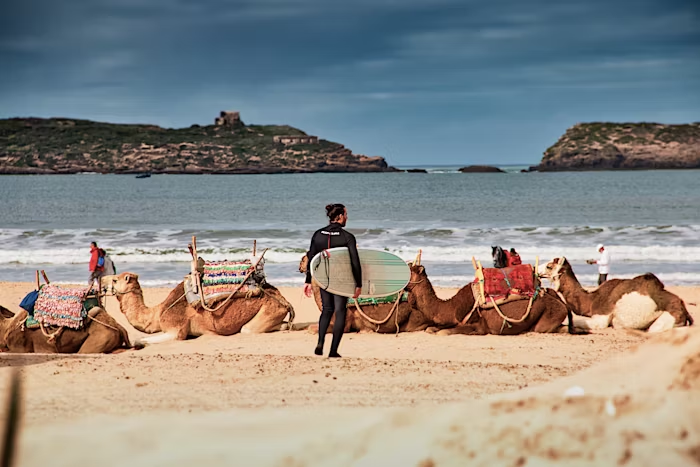
- Sunset camel ride in the Zagora desert
- 1 night in a private Berber desert tent (en-suite bathroom option available)
- Dinner Day 1 at camp: 3 Moroccan salads, tagine, fresh bread, mint tea
- Breakfast Day 2 at camp: msemmen, amlou, honey, eggs, orange juice, mint tea
- Live Gnawa or Berber music around the camp fire
- Hotel pickup and drop-off in Marrakech
❌ Not Included:
- Lunches (recommended at Aït Benhaddou Day 1, Draa Valley Day 2)
- Travel insurance
- Personal expenses and souvenirs
- Tips for driver-guide, camel guide, and camp staff
We confirm your pickup time and route within 24 hours.
2-Day Zagora Tour from Marrakech — Day by Day {#itinerary}
Day 1 — Marrakech to the Desert Camp
Private vehicle pickup from your Marrakech hotel or riad at 7:00 to 7:30 AM. The road heads south immediately, climbing out of the Haouz Plain and into the High Atlas. The Tizi n’Tichka pass at 2,260 metres — Morocco’s highest paved road — takes roughly 2 to 2.5 hours from the city; the hairpin bends above the treeline, the Berber villages at impossible angles on the canyon walls, and the panoramic view back across the plain as Marrakech disappears below make this the first genuinely dramatic section of the Zagora desert tour from Marrakech. Photo stops are built into the pass crossing.
Aït Benhaddou — Inside the Walls
The Aït Benhaddou ksar is the most dramatic fortified village in Morocco — a UNESCO World Heritage Site since 1987 and the backdrop for Lawrence of Arabia, Gladiator, and multiple Game of Thrones episodes. A local guide meets the group at the base of the ksar and leads a 45 to 60-minute walk through the mud-brick alleys, past the granaries and the communal bread ovens, to the uppermost point with its panoramic view of the Ounila Valley and the Atlas beyond. A family-run terrace restaurant above the ksar is the right lunch stop — tagine, bread, and olives with the fortress walls visible below.
Ouarzazate and into the Draa Valley
A brief pass through Ouarzazate — the film-studio city that gave Morocco the nickname “the Hollywood of Africa” — before the road turns south-east into the Draa Valley. This is the section of the Zagora desert tour from Marrakech that most travellers find the unexpected highlight: 200 kilometres of date palm plantation flanked by ancient ksour in various states of preservation, the river valley narrowing as the pre-Saharan hammada closes in, and the quality of the afternoon light on the ocher earth turning everything amber before the desert camp appears. The village of Agdez, the old Agdez Kasbah above the valley, and the final approach to Zagora past the famous Timbuktu sign complete the day’s driving.
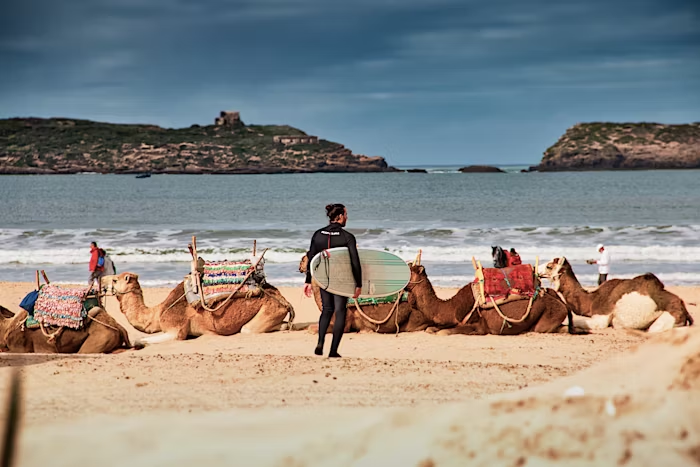
As the sun approaches the horizon, your group mounts camels for the sunset ride across the hammada — the flat stone desert plateau characteristic of the Zagora region. This is not Erg Chebbi; there are small dunes but the dominant landscape is open stone plain, Jbel Zagora on the skyline, and a silence more complete than most European or North American travellers have ever experienced. The camp is a private Berber tent arranged for your group. Moroccan mint tea arrives immediately. As darkness settles the temperature drops sharply and the stars appear — at this distance from any city, the Milky Way is visible to the naked eye on clear nights. Dinner follows: three salads, a slow-cooked tagine, fresh bread, mint tea. Gnawa or Berber musicians play by the fire; the participation is optional but the music, at this remove from everything, is the right sound for the evening.
Day 2 — Sunrise and the Long Return
Wake before dawn — around 5:30 AM. The short walk or camel ride to the nearest dune or ridge as the desert sky shifts from black to deep purple to rose is the photographic peak of the entire Zagora desert tour from Marrakech. Moroccan breakfast at the camp after sunrise: msemmen, amlou, honey, olive oil, scrambled eggs, fresh orange juice, mint tea. Depart camp around 8:00 to 9:00 AM. The return follows the same route in reverse — Draa Valley northward, Ouarzazate, the Tizi n’Tichka from the south — the landscapes in entirely different light and the Atlas now a wall ahead rather than behind. Stops at the driver-guide’s discretion for photos and rest. Arrival in Marrakech approximately 6:00 to 7:00 PM.
Zagora Desert Tour from Marrakech Highlights {#highlights}
The Draa Valley — Morocco’s Longest Palm Corridor
The Draa Valley between Agdez and Zagora is one of the most sustained and undervisited landscapes in Morocco — 200 kilometres of date palm oasis along the Draa river, ancient ksour crumbling at various points into the stone desert on either side, and a succession of Berber villages whose terraced gardens and palm-shaded streets feel entirely unchanged by the tourism that fills Marrakech’s medina. The Zagora desert tour from Marrakech drives the entire length of this valley on both days, which means you see it twice in different light — the amber glow of late afternoon southbound and the cool morning clarity of northbound.
Aït Benhaddou Beyond the Car Park
Aït Benhaddou with a good local guide is a fundamentally different experience from Aït Benhaddou with a 45-second photo stop from the car park. The guided walk takes you inside the walls — through passages too narrow for two people abreast, past private homes with carved cedar doorframes still in place, into the uppermost granary with its view across the full ksar and the Ounila Valley below. This is one of the most atmospheric buildings in North Africa, and it rewards the time the guided walk gives it.
Private Desert Camp vs a Shared Experience
The Zagora desert tour from Marrakech is available from dozens of operators, most of whom run it as a shared group experience of 15 to 100 travellers in a shared camp. The dinner is communal, the music is staged, the camel ride leaves in a convoy. Our version is private: your group, your tent, your table at dinner, your camel line at sunset. The desert camp experience in particular — the silence, the stars, the camp fire — is structurally different when it is your group of four rather than a mixed group of fifty. Explore all our Morocco tours to see how the Zagora circuit compares with our Merzouga and full grand circuit options.
Practical Information {#practical}
The drive: Marrakech to Zagora is 350 kilometres each way, seven to eight hours of driving per day including stops. This is the key practical fact of the Zagora desert tour from Marrakech — it is a long-drive tour. The scenery is genuinely beautiful throughout, the driver-guide manages the pace and stops, and most travellers find the driving less onerous than they expect in a private vehicle where you control the music, the stops, and the conversation. But it should be understood before booking, not discovered on the road.
The desert: Zagora is hammada — flat stone and rock desert — with small sand dunes. It is not the Sahara’s great erg dune fields. The sunsets and sunrises are dramatic, the silence is absolute, and the camp fire under the Milky Way is one of the genuine experiences of the trip. But the visual vocabulary is different from the tall-dune landscape of Merzouga, and travellers who arrive expecting orange dune silhouettes are occasionally disappointed.
Season: Spring (March to May) and autumn (September to November) are the best months for the Zagora desert tour from Marrakech — mild temperatures throughout the route, the Draa Valley at its most photogenic. Summer (June to September) is very hot in the desert and valley sections — 40 to 45°C possible in July and August. Winter (December to February) is cold in the Atlas and the desert nights drop to near-freezing — bring warm layers and a sleeping bag liner if visiting in winter.
What to pack: Layers for the temperature range (Atlas pass is cool, desert afternoon is hot, desert night is cold). Closed-toe shoes for the Aït Benhaddou walk. A headscarf or buff for the camel ride — the hammada wind carries dust. Sunscreen and sunglasses throughout. A torch for the camp. Leave heavy luggage in Marrakech — a small overnight bag is all you need at the desert camp.
Frequently Asked Questions {#faq}
How long is the drive from Marrakech to Zagora?
Approximately seven to eight hours each way, including stops — 350 kilometres on a good road that crosses the Tizi n’Tichka pass at 2,260 metres, descends into the pre-Saharan south, passes Aït Benhaddou and Ouarzazate, and follows the Draa Valley into Zagora. In a private vehicle with your own group and a driver-guide managing the stops, most travellers find it more comfortable than expected — the landscapes are continuous and genuinely beautiful. The return journey covers the same distance, meaning the Zagora desert tour from Marrakech involves roughly 14 to 16 hours of total driving over the two days.
Is Zagora desert sand dunes or rock desert?
Zagora is hammada — Morocco’s stone and rock desert plateau — with some small sand dunes. It is not an erg dune field in the Saharan sense. The landscape is dramatic and austere, the sunsets and sunrises are exceptional, and the desert silence is complete. But the visual experience is different from the tall orange dunes at Erg Chebbi (Merzouga). If towering sand dunes are your primary goal, the Merzouga route is the right choice.
What is the difference between a Zagora tour and a Merzouga tour?
The key differences are distance, driving time, landscape, and what you see en route. Zagora is 350km from Marrakech (7–8 hours); Merzouga is 550km (10–11 hours). The Zagora route goes south through the Draa Valley — one of Morocco’s great landscapes; the Merzouga route goes southeast through the kasbah route and the Dadès and Todra gorges. Zagora has hammada stone desert with small dunes; Merzouga has Erg Chebbi, Morocco’s most famous sand dune field at up to 150 metres high. The Zagora tour can be done in 2 days/1 night; the Merzouga circuit typically requires 3 days/2 nights minimum for a satisfying experience.
What is included in the Zagora desert tour from Marrakech?
Private vehicle and driver-guide throughout, guided visit of Aït Benhaddou with local guide fees, sunset camel ride, one night in a private Berber tent, dinner (Day 1) and breakfast (Day 2) at the camp, live camp music, and hotel pickup and drop-off in Marrakech. Lunches are not included — recommended at Aït Benhaddou on Day 1 and at a Draa Valley restaurant on Day 2.
What is the best time of year for a Zagora desert tour?
Spring (March to May) and autumn (September to November) are the most comfortable months — mild temperatures in the Atlas, the Draa Valley vivid and photogenic, desert nights cool but not cold. Summer is very hot in the desert sections (40 to 45°C in July and August); winter is cold in the pass and the desert at night. The Zagora desert tour from Marrakech runs year-round — winter visits have the advantage of a virtually empty desert and exceptional clarity — but spring and autumn give the best all-round conditions.
How to Book Your Zagora Desert Tour from Marrakech {#book}
Send us a message on WhatsApp — +212 724 593 208 — or email contact@yourguidetomorocco.com with your travel dates, group size, hotel name, and any dietary requirements or questions. We confirm within a few hours — usually much faster.